When Voice of the Emperor Ends Are They Hostile Again
Introduction
It all began with a sign. Posted on phone poles, park benches, community centers, and a Woolworth'due south, Executive Order No. 9066—issued by President Franklin D. Roosevelt—sought to prevent "espionage and sabotage" by citizens of Japanese descent in the wake of the 1941 bombing of Pearl Harbor. Japanese Americans were arrested, rounded up, and transported to detention centers across the United States, where in some cases they were held for several years.
This sign, introduced in the first line of Otsuka'south novel When the Emperor Was Divine, prompts "the adult female" to brainstorm packing important holding. Afterwards her children return from schoolhouse and work quietly on their homework, the woman tells them that tomorrow they "will be going on a trip." That trip volition have them from a comfortable existence at their home in Berkeley, California, to a sterile and uncomfortable internment site in Topaz, Utah, "a urban center of tar-paper billet backside a barbed-wire fence on a dusty alkaline plain high up in the desert."
Otsuka'southward novel unfolds in five different but interconnected narrative perspectives, and moves hauntingly through the family's internment experience in the voices of the mother, daughter, son, and father. The woman and her children recount, in sober item, the daily events of their journey to—and time in—Topaz, where besides the internees, their barracks, and the soldiers, there was "just the current of air and the dust and the hot burning sand."
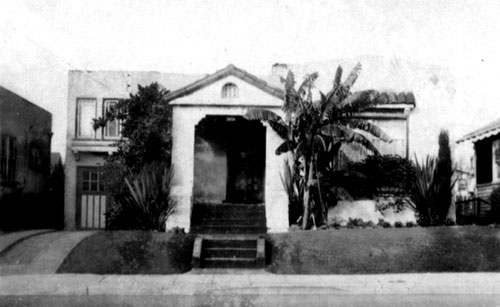 California Business firm (Courtesy of the Otsuka family unit)
After the war, the family is permitted to render dwelling. But they return to a neighborhood neither familiar nor hospitable. Their dwelling has been vandalized, their neighbors are at best aloof or at worst hostile, and their sense of place in America is forever changed.
Though the novel tells a powerful story of the fear and racism that led to exile and breach, Otsuka weaves a compelling narrative full of life, depth, and character. When the Emperor Was Divine non simply invites readers to consider the troubling moral and civic questions that emerge from this period in American history but also offers a tale that is both incredibly poignant and fully human.
Major Characters in the Novel
The woman
Following her married man'due south arrest past the FBI later Pearl Harbor, the woman is faced with abandoning her family unit's comfortable dwelling and abruptly becomes sole caregiver of her two children. With a sense of both resignation and resolution, she manages to agree her family together throughout their forced internment.
"That evening she had lit a blaze in the thousand ... She smashed the abacus and tossed it into the flames. 'From now on,' she said, 'nosotros're counting on our fingers.'" —Julie Otsuka, from When the Emperor Was Divine
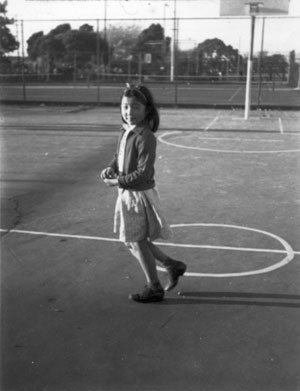 Julie Otsuka's mother (Courtesy of the Otsuka family)
The girl
A child of x when the story begins, the daughter's growing sense of the hard realities of the family's state of affairs stands in sharp dissimilarity to her brother's innocence. Although she wears Mary Janes, owns a doll from the Sears itemize, and enjoys blackness licorice and Dorothy Lamour, this sense of her American identity, equally well equally her heritage, will be challenged by the novel's events.
"Her watch had said six o'clock for weeks. She had stopped winding information technology the day they had stepped off the train." —Julie Otsuka, from When the Emperor Was Divine
The boy
An viii-year former with a child's natural instincts to make the all-time of whatever state of affairs, the boy struggles with the absenteeism of his father, whom he sees everywhere, fifty-fifty in his dreams. He passes the time playing cops and robbers and war, and interests himself in the radio and magazine accounts of the conflict overseas, simply his male parent'south absence proves a deep sadness in his life.
The father
Arrested and sent away prior to the opening of the novel, the begetter's presence through much of the story is seen at a distance through his letters to his married woman and his children. Later on his extended detention at the Lordsburg Facility in New Mexico, he returns home to his family a hollow man. His narration in the novel surfaces angrily in the final chapter titled "Confession."
Julie Otsuka (b. 1962)
Julie Otsuka was born in Palo Alto, California, in 1962 to parents of Japanese descent. Her begetter, an Issei or Japanese immigrant, was an aerospace engineer. Her mother, a Nisei or second-generation Japanese American, was a laboratory technician before Julie's birth.
Otsuka excelled in schoolhouse, and eventually moved east for college. In 1984 she earned her Available of Arts degree at Yale University. Through her early 20s she studied to be a painter, but decided instead, after suffering a self-described "creative breakdown," to turn her attention to another fine art class: writing.
In New York City the seeds of a highly successful career were planted when she enrolled in a writing workshop. Otsuka earned her MFA in writing from Columbia University in 1999. Part of her MFA thesis became the first ii chapters of her novel When the Emperor Was Divine, published in 2002.
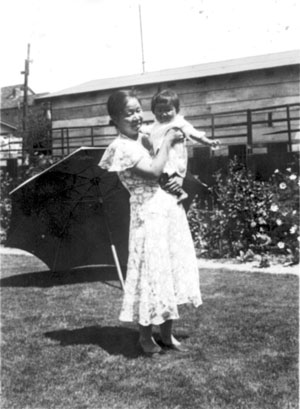 Julie Otsuka's mother and grandmother (Courtesy of the Otsuka family)
Otsuka's family unit history figures prominently in the novel. A day afterwards the bombing of Pearl Harbor, her grandfather was arrested past the FBI on suspicion of existence a Japanese spy. Her mother, grandmother, and uncle were subsequently interned at a camp in Topaz, Utah. Otsuka drew on both enquiry and personal experience to craft this debut novel, which won the American Library Association'due south Alex Award and the Asian American Literary Award in 2003. Emperor has been assigned to outset-twelvemonth students at more than 45 colleges and universities.
Published in 2011, Otsuka'due south second novel—The Buddha in the Attic—is based on Japanese "picture brides" who were brought to America to marry men they had never met. In 2012 information technology won the PEN/Faulkner Honour for fiction and was a finalist for the 2011 National Book Accolade, among other notable recognitions.
The literary journal Granta published three of her short stories, "Come up, Japanese," "The Children," and "Diem Perdidi," the showtime 2 of which were excerpts from her novel The Buddha in the Cranium. Her short story, "Whites," which is another excerpt from The Buddha in the Attic, was published by Harper'southward. Her work has also appeared in The All-time American Short Stories 2012 and The Best American Not-required Reading 2012.
Otsuka says she writes every day at her local café.
Updated July 2017
An Interview with Julie Otsuka
On February 6, 2014, Josephine Reed of the National Endowment for the Arts interviewed Julie Otsuka. Excerpts from their conversation follow.
Josephine Reed: The chief characters (who are the narrators of the story) are nameless. Why did y'all make that option?
Julie Otsuka: I actually had written an earlier version of the get-go chapter in which the mother had...a Japanese surname, and every bit I continued to write about these characters I thought information technology seemed more constructive really to un-name them. I was really interested in the psychology of the situation. [I] happened to exist writing near Japanese Americans simply...could have been writing about any ethnic group at whatsoever bespeak in history. I feel like there has always been some other group that's been expelled and sent away, and I likewise thought that my characters were people from whom everything had been taken: their liberty, their belongings, their sense of cocky. And I think that the one thing that you can't take away from someone is their name, so I wanted to leave them but some tiny shred of self so only they and they alone know who they are.
"1 evening, before he went to bed, he wrote his name in the dust across the elevation of the tabular array. All through the dark, while he slept, more dust blew through the walls. By morning his name was gone."
—Julie Otsuka, from When the Emperor Was Divine
JR: It's likewise interesting because each character is telling us a different segment of the story.
JO: [T]he daughter is right on the cusp of adolescence and I think she's in a semi-rebellious stage, even if she happens to be in an internment camp; she'southward a very kind of feisty girl. And the boy is a piffling younger, he'south vii when the novel starts; and he'south a trivial scrap too immature to understand what's going on. He's a very dreamy child and very much a magical thinker and he thinks in the way that children oftentimes do that everything is his fault, that anybody is existence sent away because he's done something wrong.... And even if he'due south in a camp in the middle of the desert for three and a half years, I feel children have this sense of wonder and connection to nature. He's still very compelled by the natural world around him, by the scorpions, by lizards, by snakes, by turtles but in the way that children are. And and so it's not an utterly dour and devastating experience, although in many ways it is, only I experience like at that place are these kind of moment spots of color and he's merely—he'southward very innocent and he...makes up stories about why he is where he is.
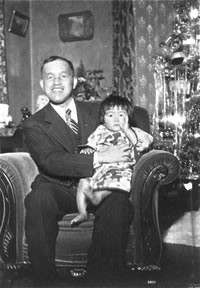 Julie Otsuka's mother and grandpa (Courtesy of the Otsuka family unit)
[T]he indicate of view of the father is kind of held back throughout the entire novel. He's just this missing presence who we see glimpses of through the other characters, their memories of the father, their dreams of the male parent. And when we finally meet him at the stop of the novel, when he's reunited with the family, he'southward not the man that...his married woman and children recall. He'south a very bitter, angry human being and clearly something has happened to him while he'southward been away and detained only we don't know exactly what. Then at that place's this burst of anger at the very finish of the novel which again came to me equally a surprise...[but] looking back I think the novel's merely a very wearisome, simmering buildup of nerves; in that location's all this tension that'due south built up. And throughout [the mother'southward] emotions are very, very deeply buried. On the surface she tries to remain very calm for the sake of the children just...there has to be a release to that tension somewhere and I feel like there is at the end of the novel with the father's angry rant.
JR: In the chapter where the family comes home, function of what you explore is the way they're coming to grips with their racial identity. In that affiliate, they're very much rejecting things that are Japanese.
JO: [T]hey were ashamed and also they're children. They still don't quite sympathise, but I recollect they don't want to exist identified with anything that's Japanese. And of course right afterward Pearl Harbor was bombed, American families were just burning all of their Japanese things. There were bonfires in everyone's backyard. And so they come dorsum and all they want to practice—I think all any kid wants to do is on some level is simply really to fit back in. They don't desire to stand up out, so they really try to downplay their Japanese-ness as much as they can, and yet they're still seen as beingness very strange...by their classmates. But they're determined never to be seen equally the enemy over again, which, I think, in some manner means further rejection of their parents.
"Sometimes he worried he was in that location because he'd washed something horribly, terribly wrong. Only then when he tried to retrieve what that horrible, terrible thing might exist, it would not come to him."
—Julie Otsuka, from When the Emperor Was Divine
JR: The book was published in the twelvemonth following 9/11, and it has a very detail resonance in that context.
JO: I finished writing the novel in June of 2001, so I had no idea that it would resonate in the manner that information technology has mail service-ix/11 as a sort of cautionary tale about what can happen when the regime starts singling out ethnic groups as being the enemy. So, I thought the volume, if I were lucky, might exist respectfully reviewed equally a historical novel. But I call up for many, many Japanese Americans, 9/11 just brought back and so many memories. It was just all so very, very familiar. You lot just had a group that overnight becomes the enemy. And I think it brought up a lot of unpleasant memories for many of the older Japanese Americans. You have people existence rounded up in secret and sent away to surreptitious detention camps and Guantanamo. I think existence a unsafe enemy alien is not that unlike being an enemy combatant. And there are but all these eerie parallels, and I always thought while writing the novel that this could never happen once again, just information technology just seems like in and so many means we never learn from history.... I've been traveling the land for years and speaking to many immature people about the camps, but a lot of them take not heard about the camps notwithstanding. I call back information technology'south not something that's included in most American history books, and so some of them are surprised...they'll say, "This is a work of fiction, right? It didn't really happen." I'll take to explicate that, yes, information technology is a work of fiction, but it is based on a very big and often omitted historical truth.
JR: And it was very moving in the period after 9/11, because as y'all say, Japanese Americans tend not to speak very often about the camps and their experiences, but many, many spoke upwards right after nine/11.
JO: They did, and many reached out to Arab American, Muslim American groups, likewise, and I remember it's very hard for Japanese Americans to speak upwards and assert themselves, especially Japanese Americans of that generation. I think it was a very of import affair for them to practise, to achieve out and to say, "You are not lone," and but to be a living lesson in history on what can go incorrect.
When the Emperor Was Divine Readers Knit Hope Blanket in Miami, FL
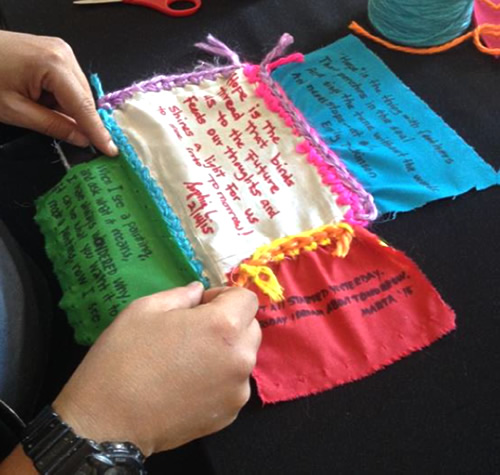
Artist Carlos Alejandro wove participants' haiku into a community blanket for hope as part of their When the Emperor Was Divine programming. Photo by Nicole Swift, courtesy of The Middle for Writing and Literature @MDC.
– from a concluding report past the Miami Dade College, an NEA Big Read grant recipient in 2014-xv.
When the Emperor Was Divine Inspires a Japanese tea ceremony sit-in in Pittsburg, PA
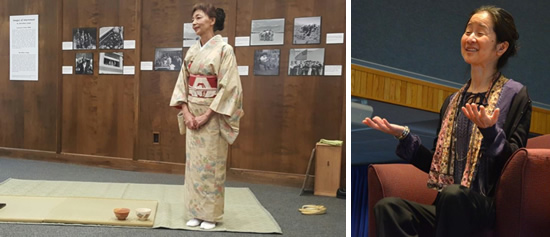
Every bit part of their NEA Big Read activities, Duquesne University hosted a Japanese tea ceremony sit-in (above left) and also brought writer Julie Otsuka to speak (higher up right). Photos by Ian Hurley and Sara Baron
"Gumberg Library was able to strengthen its ties and place in the campus customs, working with instructors, the university president, provost, deans, students and staff. In fact, during the programming Duquesne's President Ken Gormley began a word serial focused on ceremonious discourse. The themes of the program resonated with the Big Read novel and nosotros discovered serendipitously that information technology was a perfect fit. We chose this novel because it is and then closely aligned with our mission and being able to fit our programming easily into the President'south new initiative was an added indication of impact.
"Without the NEA Big Read support, nosotros could never have brought the author, Julie Otsuka, to our campus. Her visit made a huge touch on over 350 people who attended her talk. This type of experience is and so unique; even when authors visit Pittsburgh, the events are frequently expensive which limits community access to them. The NEA Large Read back up allowed us freely to give away 950 copies of the novel. This had a positive bear upon on the number of readers we were able to reach and involve in the plan. Over ane,400 people participated in our Big Read of When the Emperor was Divine and if all of them actually read the novel, we believe that the touch on of Otsuka'southward story will be felt in their lives for many years to come."
– from a final report past Duquesne Academy, an NEA Big Read grant recipient in FY 2016-17.
Partnerships and Creative Programming Extend Accomplish of Events Beyond the Country
Throughout the FY 2014-2015 programming year, partnerships with Japanese cultural organizations helped grantees provide a cultural context. The Center for Literature and Theatre @ Miami Dade Higher planned a visit to the Morikami Museum and Gardens. The Salt Lake Metropolis Public Library was able to offer its participants an immersive experience with the historical events of the book through a tour of the Topaz internment army camp site, located in nearby Delta, Utah, and a customs fellow member's recollections of his own time spent at the Topaz camp. The Palo Alto Children'south Theatre worked with the Japanese American Citizens League and the Palo Alto Buddhist Temple to create a Palo Alto Day of Remembrance to recognize the impact internment had on its community.
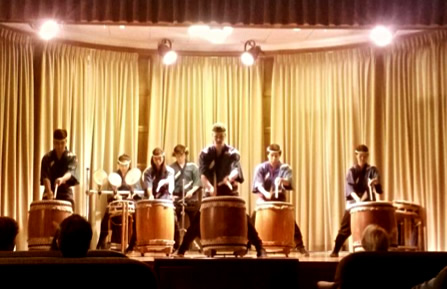
Stanford Taiko performing at an "Art of Acceptance" consequence. Photo courtesy of Palo Alto Children's Theatre.
Baseball Game Provides a Segue to Reading in Attleboro, Massashusetts
"Our well-nigh successful events take always been the family oriented events too every bit our keynote speaker. Kicking off with baseball at our City's 100th Ceremony was a big hitting on a very hot, humid solar day. It brought many individuals who had not heard of NEA Big Read, allowed for a comfortable and enjoyable segue into the reading of the volume. It also highlighted a very American action that was the activity of pick by many of the men and boys in the camps. The Japanese American Cultural Day provided opportunities for families, adults, and children to try some cultural crafts, math skills, food, and to learn about Japanese Culture. Our discussions and volume giveaways at 3 varying community events - City'south 100th, the Farmers Market place and the Lee's Pond Festival brought the Big Read to three varying locals in the Urban center ‐ the Central, the South and Eastern parts of Attleboro. Combining a discussion, craft, and book giveaway made our table a "place to be" for all ages. The Attleboro Area Bar Association sponsored "Civil Liberties And so and Now" was so well received that many in the audience wished we had gone over the ane½ hour console discussion."
"Our keynote speaker, Margie Yamamoto, was very highly received. Much praise for her presentation and apology for what her family unit endured, were given by several audience members. It is likely that our local high schoolhouse will bring her back during the year as the diverse English and history classes read the book."
"The Attleboro Arts Museum art finale always defines the essence of our title and experience. The artistic use of keys created a reflective surround for observers and artists to decide what is well-nigh important in their own lives."
"The NEA Big Read has brought fellowship, a sense of community, and an 'alibi' for many individuals to cease in the library, the museum, or other venues to participate in what is going on. It brings a purpose and reason to be with other community members to enjoy and talk about the experience of the NEA Large Read. Of grade, nosotros have our usual followers, just each year, we run into new faces, hear new personal stories, and receive more than thanks for what we are doing. I believe our keynote speaker says it best when describing the impact on our community. Margie stated 'I can't begin to thank you plenty for inviting me to speak for your Big Read project. I accept been giving various versions of this talk for over four years and this was the most responsive, receptive and knowledgeable group I've had the honor to address. All credit must get to y'all and the wonderful work you did around When the Emperor was Divine.' We had over 100 people nourish‐ others are asking when it will be on cable as they could non attend. A member of the audience offered a tearful apology to Margie for what our country had done. Many customs members individually allow u.s.a. know that they had never realized that such a thing had happened in our country. Thus, The Big Read brought enlightenment, encouragement, and date to our community this year."
– from a report by the Attleboro Public Library, an NEA Big Read grant recipient in FY 2014-2015.
Source: https://www.arts.gov/initiatives/nea-big-read/when-emperor-was-divine
0 Response to "When Voice of the Emperor Ends Are They Hostile Again"
Post a Comment